In both still photography and motion picture cinematography, the camera sensor records only what light illuminates. While novice creators rely entirely on ambient daylight, commercial masters understand how to sculpt, shape, and mathematically control artificial light to create three-dimensional form, emotional tone, and commercial polish.
Studio lighting is an exact balance between physical wave science and creative visual psychology. Mastering studio lighting begins with understanding how light behaves across space, surface textures, and camera planes.
1. The Physics of Light Quality: Hard vs. Soft Light
The perceived hardness or softness of light is determined by one primary physical variable: the relative size of the light source compared to the subject.
- Hard Light (Small Relative Source): When the light source is physically small or positioned far away from the subject, light rays travel in parallel paths. This casts deep, razor-sharp shadow edges and emphasises skin texture, angular bone structure, and high-frequency surface details.
- Soft Light (Large Relative Source): When a light source is expanded using modifiers (such as 120cm parabolic soft-boxes or diffusion scrims) and positioned close to the subject, light rays wrap around contours from multiple angles. This creates gentle, feathered shadow transitions that flatter fashion portraits and commercial beauty setups.
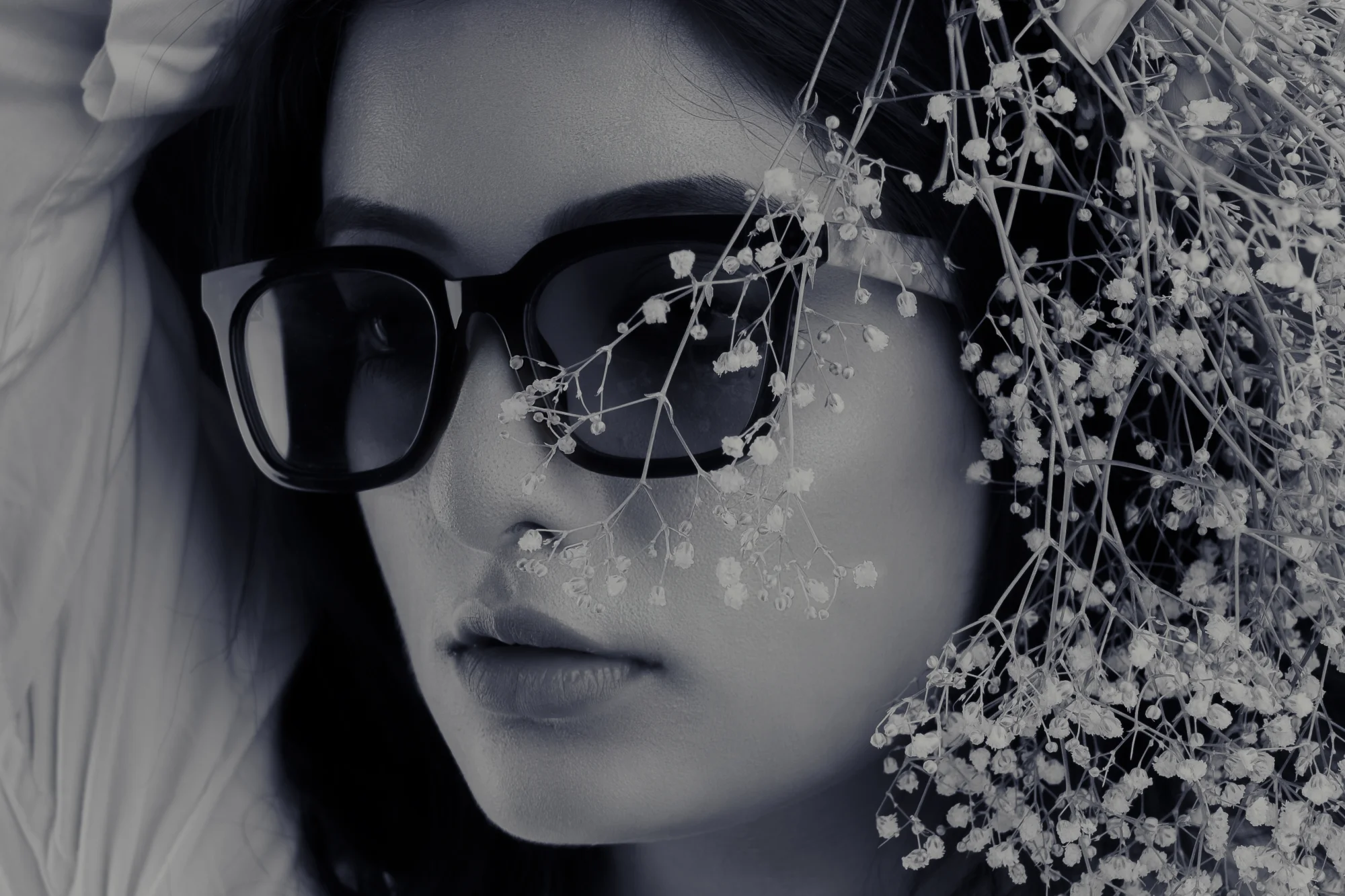
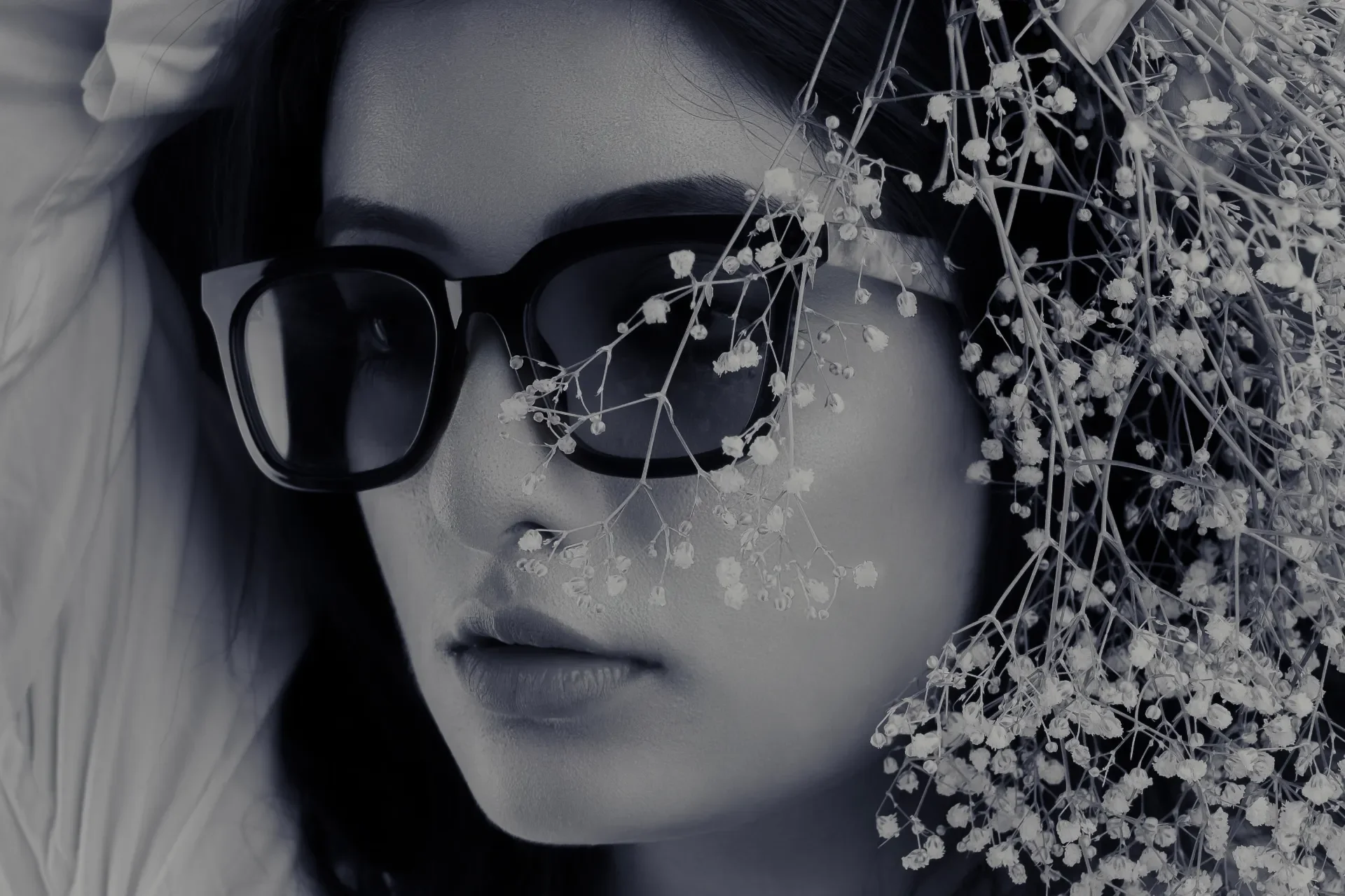
Image captured by the founder of RAP Education Photography School, Riddhi Bhattacharjee 2022 using only one soft light.
2. The Inverse-Square Law: Light Falloff Mathematics
The Inverse-Square Law is the foundational physical law governing artificial lighting in a studio:
Illuminance (I) = 1 ÷ (Distance)²
Light intensity drops off inversely proportional to the square of the distance between the light source and the subject:
- 1 Metre to 2 Metres: Doubling the distance from 1m to 2m reduces light intensity to 1/4th (25%) of its original power—a massive loss of 2 full stops (-2 EV).
- 2 Metres to 4 Metres: Moving the light from 2m to 4m drops the intensity to 1/16th (6.25%) of the initial output.
How to Use Falloff Creatively in the Studio:
- High Contrast / Fast Falloff: Placing a softbox very close to a subject creates rapid light falloff. The subject's key side is brightly exposed while the opposite side and background drop off swiftly into dark, dramatic shadows.
- Even Illumination / Slow Falloff: Moving the light source further back (and increasing strobe power) flattens the falloff curve across the depth of the set, ensuring both foreground subjects and background backdrops remain evenly exposed.
3. The 3-Point Lighting Architecture
The classical three-point lighting setup is the industry standard for commercial interviews, editorial portraits, and cinematic character framing:
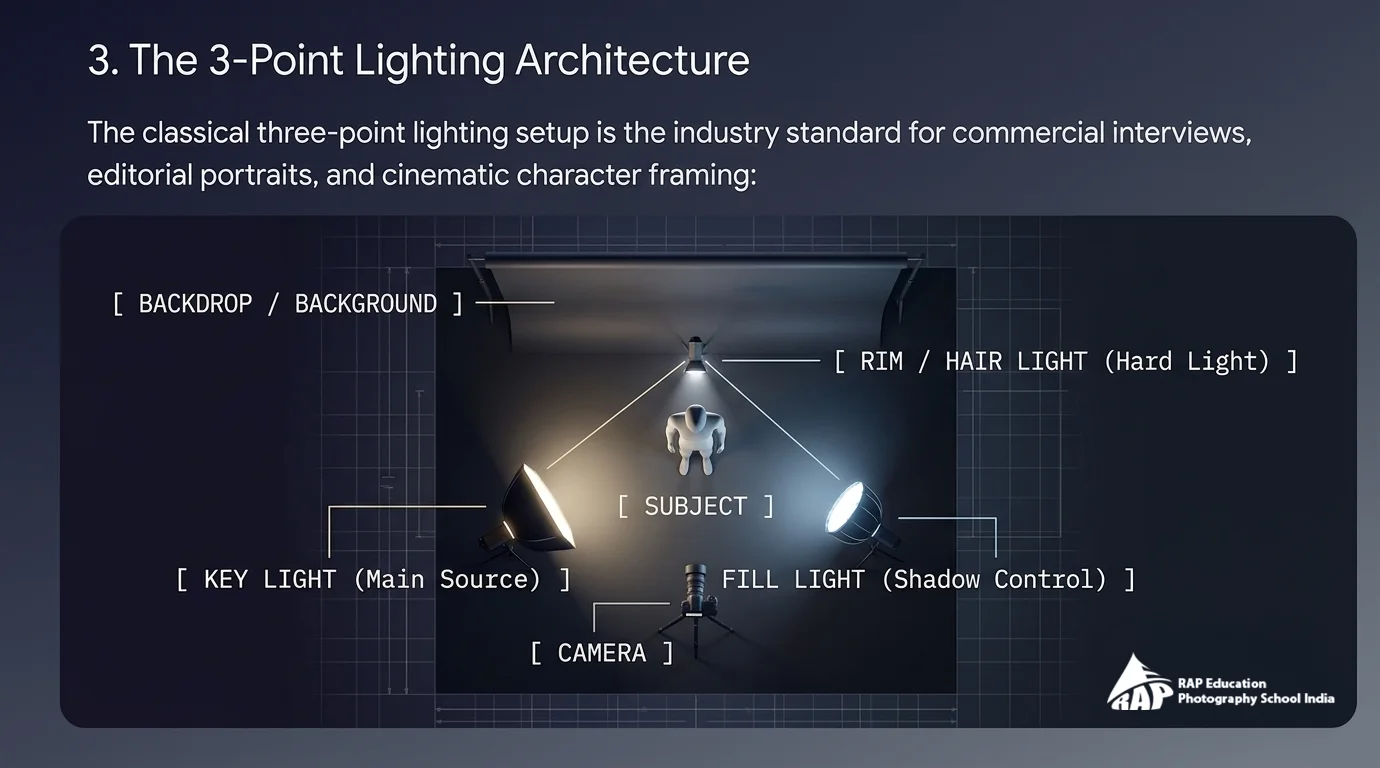
A. The Key Light
The dominant light source in the scene. It establishes overall exposure, sets the mood, creates directional shadows, and produces the primary catchlight in the subject’s eyes. Typically placed at a 45-degree angle to the subject and angled downward at 45 degrees.
B. The Fill Light
Positioned on the opposite side of the camera axis to open up shadow detail cast by the Key Light without creating a secondary competing shadow. Fill can be provided by a lower-powered strobe, a continuous LED panel, or a passive white/silver reflector.
C. The Rim / Back Light (Hair Light)
Placed behind and above the subject, pointing toward the back of the head or shoulders. It creates a crisp outline of light separation, visually pulling the subject away from dark backgrounds to ensure three-dimensional visual depth.
4. Lighting Ratios & Contrast Dynamics
Lighting ratios measure the relative luminance difference between the brightly lit side of a face (Key + Fill) and the shadowed side (Fill only):
- 1:1 Ratio (Flat Lighting): Equal illumination across both sides. Common in high-key beauty campaigns, e-commerce catalogue shoots, and commercial cosmetics.
- 2:1 Ratio (1-Stop Difference): Subtle, natural dimensional modeling suitable for corporate headshots and commercial documentary interviews.
- 4:1 Ratio (2-Stop Difference): Pronounced shadow definition and dramatic contouring, favored in high-fashion editorial spreads.
- 8:1+ Ratio (3+ Stops Difference - Low-Key): Moody, cinematic chiaroscuro lighting used in noir films, dramatic character portraits, and suspense sequences.
5. Studio Modifiers Decoded: Sculpting the Beam
Professional modifiers shape beam angle, diffusion density, and specular highlights:
- Parabolic Soft-boxes: Deliver directional yet wrapped illumination with deep internal silver reflectors that maximise output efficiency and smooth shadow falloff.
- Beauty Dishes: Combine a central deflector shield with a shallow bowl reflector to produce a signature punchy, semi-hard light with high contrast and defined jawline definition.
- Optical Snoots & Gobos: Project razor-sharp patterns, window frames, and narrow theatrical spotlights directly onto subjects or background sets.
- Strip Boxes with Grids (Eggcrates): Restrict peripheral light spill to narrow slits, serving as precise edge lights and product rim highlights.
6. Hands-On Studio Mastery at RAP Education
Theoretical knowledge of light physics becomes second nature only when applied through continuous, hands-on experimentation.
At RAP Education Photography School, students train directly inside our fully equipped commercial studio in Kolkata. Through an official institutional partnership with The Yellow Lens, learners have unrestricted access to commercial modifiers, optical snoots, and precision continuous fixtures.
Furthermore, RAP Education is West Bengal’s only photography school offering 100% free studio access outside regular class hours. Enrolled students in our 18-Month Understanding Photography & Cinematography Professional Learning Program and 15-Month Comprehensive Course can book studio floor time at zero rental cost to experiment with lighting ratios and shoot client lookbooks.
Experience practical studio lighting under the personal mentorship of Riddhi Bhattacharjee at our Phoolbagan Campus in Kolkata.
- #Studio Lighting Techniques
- #3 Point Lighting Setup Photography
- #Inverse Square Law Light Photography
- #Softbox vs Beauty Dish
- #Key to Fill Lighting Ratios
- #Free Studio Access Photography School
- #The Yellow Lens Modifiers
- #Cinematography Lighting Course Kolkata