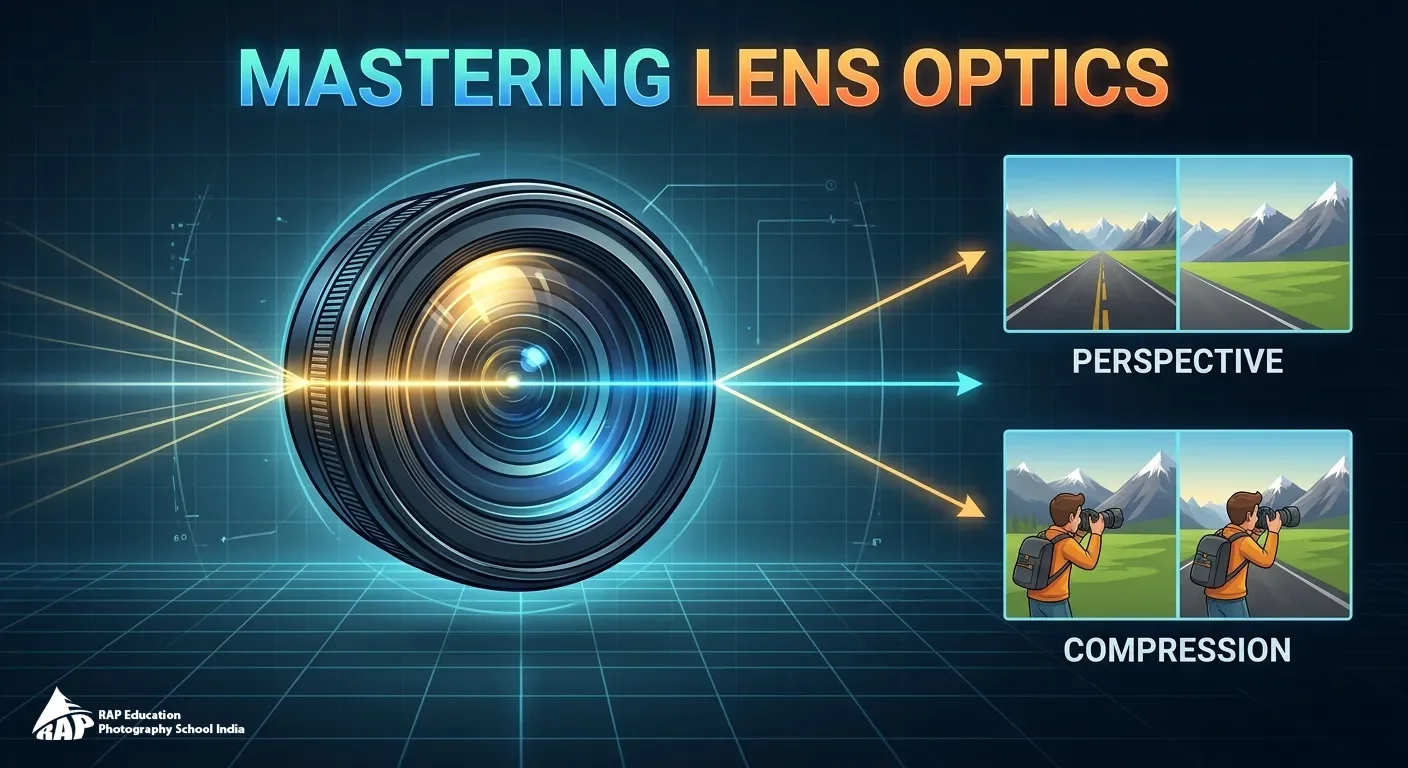
While the camera body houses the sensor engine, the lens is the true optical paintbrush of the visual artist. Every nuance of three-dimensional reality—depth perception, field of view, spatial compression, and micro-contrast—is engineered through intricate groupings of curved glass elements before light ever touches a single photodiode.
Understanding lens optics empowers cinematographers and commercial photographers to choose glass with intention, manipulating physical perspective rather than relying on digital guesswork.
1. What is Focal Length? The Optical Definition
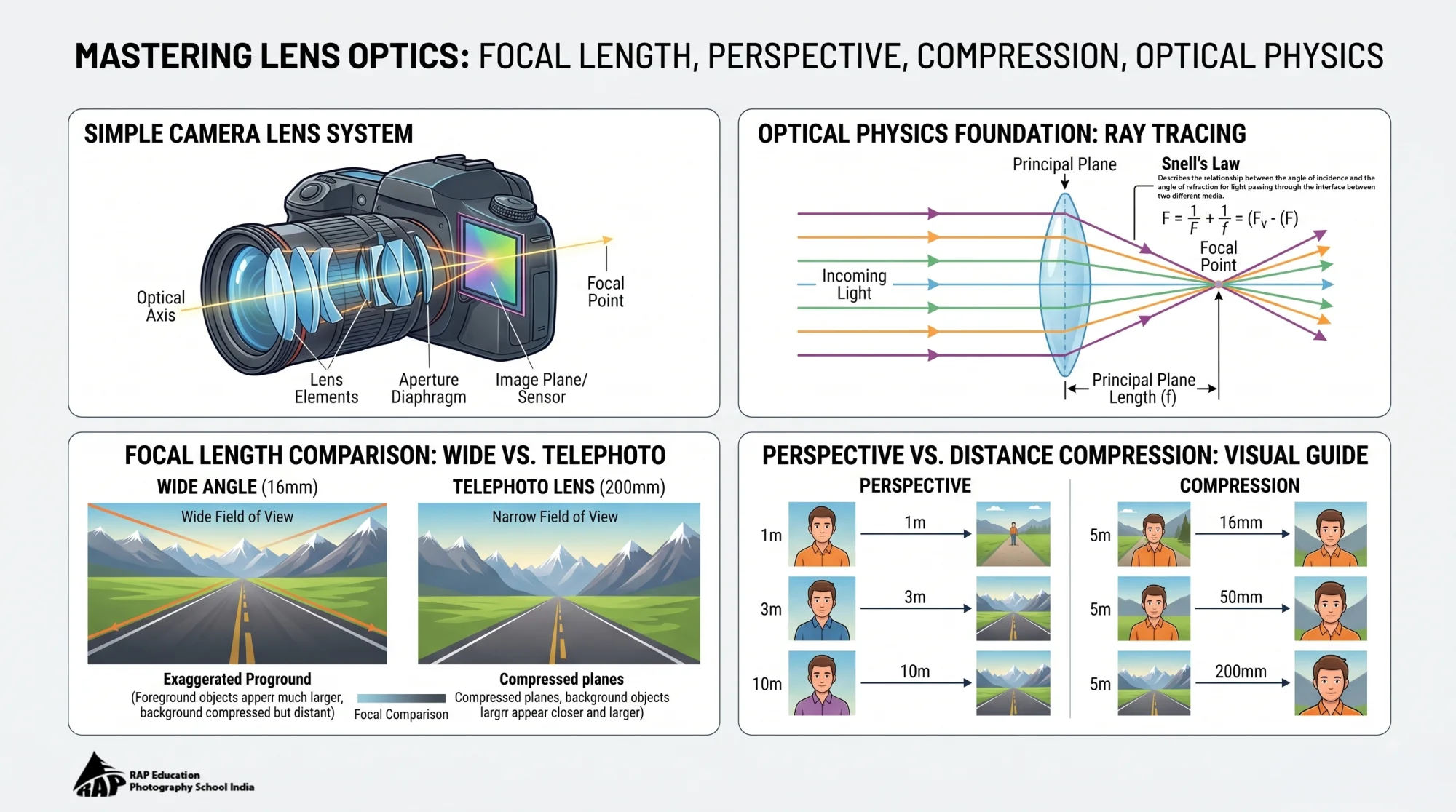
A common myth is that focal length represents the physical length of the lens barrel. In optical physics, focal length (measured in millimetres) is the precise distance from the optical centre (rear nodal point) of the lens to the focal plane (the sensor surface) when the lens is focused at infinity.
Angle of View (AoV) & Sensor Format
Focal length directly dictates the field of view recorded across a given sensor dimension:
- Ultra-Wide (12mm – 24mm): Delivers an expansive Angle of View (84° to 122°), exaggerating foreground elements and expanding spatial distance.
- Standard / Normal (35mm – 50mm): Approximates natural human central vision perspective (40° to 63°), creating organic proportions without optical exaggeration.
- Telephoto (85mm – 200mm+): Provides a narrow Angle of View (28° down to 12° or narrower), pulling distant background elements closer to the primary subject.
(Note: Sensor format changes effective framing. As explored in our deep-dive on Camera Sensor Architecture, mounting a 50mm lens on an APS-C crop sensor yields a field of view equivalent to a 75mm focal length on full-frame).
2. Perspective Compression: Distance vs. Focal Length
One of the most powerful creative tools in cinematography and portraiture is perspective compression—the visual phenomenon where background elements appear magnified and pulled dramatically closer to the foreground subject.
The Physics Behind Compression:
- Focal length alone does not physically compress space; camera-to-subject distance alters perspective.
- When you use a long telephoto lens (such as an 85mm or 135mm prime) and step back to maintain identical subject framing compared to a wide 24mm lens, the physical distance between you and the subject increases significantly.
- This increased distance diminishes the relative scale difference between the subject and the distant background, flattening three-dimensional depth and rendering a smooth, intimate backdrop.
Combined with a wide entrance pupil—as detailed in our guide on Understanding Aperture & F-Stops—telephoto compression isolates subjects with clean, creamy background blur.
3. Optical Aberrations: The Flaws in Glass Physics
No optical system is theoretically perfect. When white light passes through glass, different wavelengths bend at slightly varying angles, introducing optical aberrations:
A. Chromatic Aberration (CA)
Because light is composed of multiple spectral wavelengths, glass refracts blue light more sharply than red light:
- Longitudinal CA (LoCA): Produces green/magenta colour fringing in out-of-focus foreground and background transitions.
- Lateral CA: Manifests as high-contrast purple or cyan halos along high-frequency edges near the corners of the frame.
- Optical Solution: Premium lenses utilize Extra-Low Dispersion (ED) and fluorite elements to converge all wavelengths onto the identical focal plane.
B. Spherical Aberration & Coma
- Spherical Aberration: Occurs when light rays entering the lens periphery focus closer to the lens than rays passing through the centre, softening micro-contrast. Modern high-end glass uses Extreme Aspherical (XA) precision-ground elements to align all light cones.
- Comatic Aberration (Coma): Causes off-axis pinpoint light sources (such as stars or city streetlights) to appear flared like comets with tails. Correcting coma is critical for astro-cinematography and night urban photography.
4. Prime vs. Zoom Lenses: The Optical Trade-Off
Visual artists constantly navigate the balance between mechanical convenience and pure optical performance:
Prime Lenses (Fixed Focal Length)
- Wider Maximum Apertures: Designed with simpler internal barrel pathways, allowing fast apertures like f/1.2, f/1.4, or T1.5.
- Peak Sharpness & Contrast: Fewer glass elements mean reduced internal reflections and minimal transmission loss.
- Creative Discipline: Forces the filmmaker or photographer to physically move and engage with spatial framing.
Zoom Lenses (Variable Focal Length)
- Unmatched Flexibility: Seamlessly transitions from wide establishing shots to tight telephoto details without lens changes.
- Engineering Complexity: Requires complex moving optical groups, often limiting maximum continuous apertures to f/2.8 or f/4 and increasing physical weight.
5. Lens Coatings, Flare & MTF Charts
High-end optical engineering separates professional glass from consumer lenses through surface physics:
- Nano AR Coatings: Microscopic sub-wavelength coating structures applied to glass elements suppress internal reflections, eliminating ghosting artefacts when shooting directly into practical light sources or golden-hour backlights.
- Modulation Transfer Function (MTF): The scientific benchmark used by optical manufacturers to measure lens performance. MTF curves plot line pairs per millimetre (lp/mm) to evaluate how accurately a lens transfers contrast and fine micro-detail from the center of the optical axis to the extreme corners.
6. Master Optical Science & Cinema Glass at RAP Education
Mastering lens optics, focal length compression, and lighting dynamics is foundational to building a world-class visual portfolio.
At RAP Education Photography School, our students train directly with top-tier Sony G Master primes, cine zooms, and specialized anamorphic glass. Through practical studio sets and on-field film productions in our 18-Month Understanding Photography & Cinematography Professional Learning Program and 15-Month Comprehensive Program, you learn to command lens physics with creative confidence.
Visit our Phoolbagan Campus in Kolkata to experience hands-on mentorship under Riddhi Bhattacharjee and accelerate your career with 100% placement support.
- #Lens Optics Photography
- #Focal Length Compression
- #Chromatic Aberration
- #Prime vs Zoom Lenses
- #MTF Charts
- #Lens Flare and Ghosting
- #Photography Courses Kolkata
- #Cinematography School Phoolbagan